A warehouse can look organized when everything is standing still.
Once the workday begins, the environment changes quickly.
Employees walk between workstations. Forklifts move pallets. Trucks arrive at loading docks. Products move from receiving areas into storage and from storage into shipping. Empty pallets accumulate. Orders are picked. Inventory gets rearranged.
When all of these activities share the same space, forklift movement needs to be planned carefully.
The right equipment is part of that planning, but so are aisle dimensions, pedestrian traffic, blind intersections, loading areas, surface conditions, and the types of loads being handled.
Forklift Rental provides rental options for warehouses, construction sites, manufacturing facilities, shipping and receiving operations, retail inventory work, and other material-handling applications. Visit our Services page to explore forklift rental options for your next project or facility need.
Start by Understanding How Materials Move
Before arranging a warehouse forklift rental, look at the entire path materials take through the facility.
Where are deliveries unloaded?
Where is incoming inventory staged?
Which aisles receive the most forklift traffic?
Where do employees regularly cross equipment routes?
Where are completed orders staged for shipping?
Mapping these movements can reveal congestion points that aren’t obvious when looking at the warehouse as a collection of racks.
The goal is to understand how equipment actually moves during normal operations.
A forklift that works well in an open loading area may feel very different once it enters a narrow aisle surrounded by racks, workers, and inventory.
Measure Aisles and Turning Areas
Forklift dimensions matter in a warehouse.
Measure aisle widths, doorways, entrances, storage areas, and other restricted spaces before choosing rental equipment.
Turning space deserves particular attention.
Forklifts steer differently from passenger vehicles, and the rear of the equipment can swing outward during turns. OSHA specifically warns operators to anticipate rear-end swing and use caution when working in confined spaces and narrow aisles.
A forklift may physically fit through an aisle while still lacking sufficient room to maneuver comfortably around loads and storage racks.
Providing accurate measurements to your rental provider can help narrow the equipment options.
Consider Pedestrian Traffic
One of the biggest warehouse considerations isn’t the forklift itself. It’s everyone working around it.
OSHA recommends separating forklift traffic from pedestrians where possible. It also identifies intersections, doorways, blind corners, congested areas, and obstructed views as situations requiring additional caution.
Look at where workers regularly walk.
Do pedestrian paths cross forklift routes?
Are employees frequently stepping into aisles from behind racks?
Are there blind corners?
Are people walking through loading areas?
A good warehouse traffic plan should consider both equipment movement and pedestrian movement rather than assuming one will simply avoid the other.
Mark Traffic Routes Clearly
Predictability can improve warehouse organization.
Where practical, facilities can designate forklift routes, pedestrian walkways, loading areas, staging zones, and restricted spaces.
OSHA recommends considering pedestrian walkways, barriers, floor striping, traffic-control signs, mirrors at blind intersections, and other measures where forklifts and pedestrians operate in the same facility.
These features can help workers understand where equipment is likely to travel.
The exact traffic-control strategy depends on the facility, but the basic goal is straightforward: reduce unexpected interactions between moving equipment and people.
Match the Forklift to the Warehouse Environment
Not every warehouse needs the same forklift.
One facility may regularly move heavy pallets between loading docks and tall storage racks. Another may need compact equipment for short-distance material movement through confined areas.
Load weight, lift height, aisle dimensions, surface conditions, power source, maneuverability, and daily usage should all influence equipment selection.
When arranging a warehouse forklift rental, provide this information rather than requesting a forklift based solely on general capacity.
Forklift Rental helps businesses identify equipment based on factors such as capacity, reach, and maneuverability. Explore our forklift Services to learn more about equipment options for different material-handling environments.
When Might a Walk-Behind Forklift Make Sense?
Some material-handling tasks don’t require a traditional sit-down forklift.
A business researching a walk behind forklift rental may be looking for equipment that can be controlled by an operator walking alongside or behind the machine, depending on the specific equipment type.
OSHA notes that powered industrial trucks can be ridden by an operator or controlled by a walking operator. Different types of trucks also present different hazards and operating characteristics.
Walk-behind equipment may be worth considering for certain indoor applications, short-distance movements, or areas where compact dimensions are valuable.
However, it shouldn’t automatically be selected simply because the warehouse has narrow spaces.
Load requirements, lift height, travel distance, floor conditions, operator training, and manufacturer specifications still matter.
Think About How High Loads Need to Travel
Warehouse operations aren’t only horizontal.
If pallets need to be placed on elevated racking, lift height becomes another major requirement.
Measure the height of storage locations and understand the load weight at the required elevation.
Forklift capacity can change depending on equipment configuration and load characteristics, so the machine’s rated specifications should always be reviewed for the intended work.
Don’t choose equipment based solely on its maximum advertised lift height.
The forklift needs to handle the actual load safely at the height required by the facility.
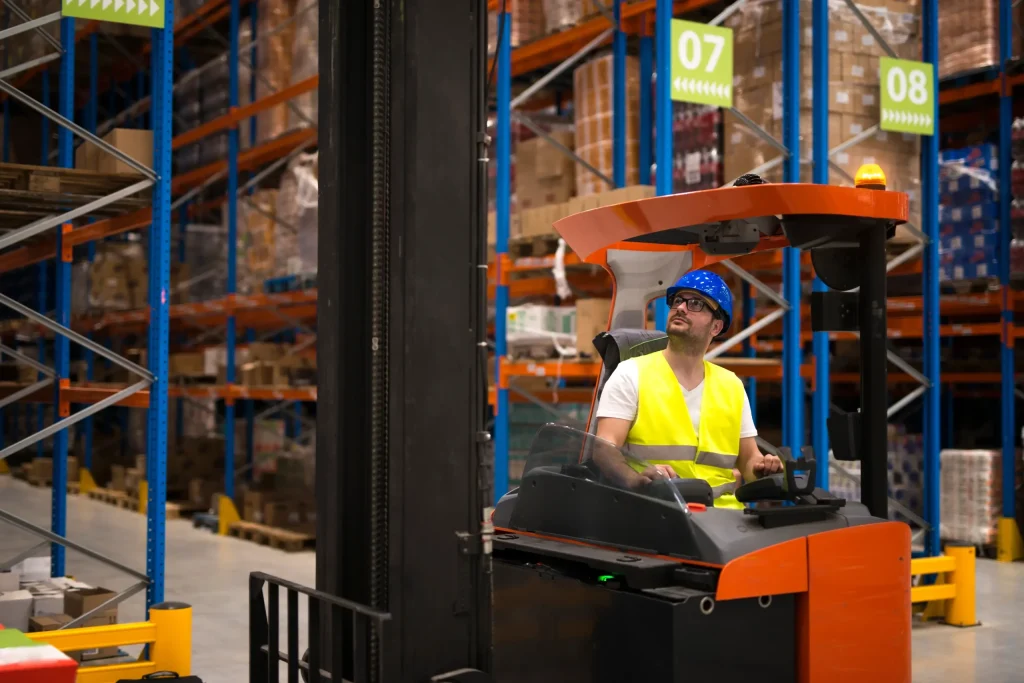
Keep Loading Docks in the Traffic Plan
Loading docks can become some of the busiest parts of a warehouse.
Forklifts may move repeatedly between trailers, dock areas, staging zones, and storage locations.
OSHA advises operators to maintain safe distances from loading-dock edges and follow appropriate procedures when traveling over dockboards or bridgeplates.
Dock areas also require coordination with trucks and trailers.
Before beginning work, businesses should ensure that appropriate procedures are in place for loading, unloading, trailer movement, and forklift access.
Don’t Ignore Visibility
Forklift operators need a clear view of their travel path.
Large loads can obstruct forward visibility. Storage racks can create blind intersections. Workers may step from aisles or doorways unexpectedly.
OSHA instructs operators to look in the direction of travel, maintain a clear view, slow down at obstructed intersections, and sound the horn at cross aisles and other locations where visibility is limited.
Facility design can support these practices through clear aisles, appropriate mirrors, signage, lighting, and pedestrian separation.
Visibility should be considered before the rental equipment ever begins moving.
Evaluate the Floor Surface
Warehouse floors may appear uniform, but conditions can vary.
Cracks, debris, wet areas, ramps, thresholds, uneven transitions, and damaged flooring can affect forklift travel.
OSHA specifically advises operators to slow down for wet or slippery floors and avoid loose objects in the travel path.
Before bringing rental equipment into the facility, inspect the expected routes.
Address obvious obstructions and make sure the operating environment is appropriate for the equipment being considered.
Capacity Is About More Than the Pallet
Knowing the approximate pallet weight is essential.
But businesses should also understand the load dimensions, center of gravity, attachment requirements, and how high the material needs to be lifted.
An unusually shaped load can behave differently from a standard pallet even if the total weight appears acceptable.
Never exceed the rated capacity of the forklift.
OSHA’s warehouse guidance emphasizes keeping loads stable and balanced and never exceeding the truck’s rated load.
If you’re uncertain about the equipment required, provide detailed load information when requesting the rental.
Operator Training Is Required
Renting equipment doesn’t eliminate the employer’s responsibility for safe operation.
OSHA requires employers to ensure powered industrial truck operators are competent through appropriate training and evaluation. Only trained and certified workers should operate forklifts covered by the requirements.
Training should also address the type of equipment and workplace conditions.
A trained operator moving materials outdoors on a construction site encounters different conditions from an operator working between warehouse racks with frequent pedestrian traffic.
The work environment matters.
Inspect Equipment Before Operation
Forklift safety also involves checking equipment before use.
OSHA’s warehouse guidance advises examining powered industrial trucks for hazardous conditions before operation.
Operators should follow the inspection requirements appropriate for the specific equipment and employer procedures.
Rental equipment should also be used according to manufacturer requirements.
Forklift Rental emphasizes well-maintained rental equipment and responsive service for businesses needing temporary or longer-term material-handling solutions.
Comparing Forklift Rental Options
Businesses often compare multiple providers before choosing equipment.
Someone searching for a united rentals forklift may be researching equipment from a large national rental provider while comparing specifications, availability, rental periods, pricing, and customer service with other forklift rental companies.
Forklift Rental is not presented here as affiliated with United Rentals. Instead, businesses can compare available equipment based on the actual needs of the project.
Look at capacity, reach, maneuverability, rental duration, delivery options, equipment condition, and support rather than selecting a provider based solely on name recognition.
Choose the Rental Period Around the Work
Warehouse forklift needs can be temporary or ongoing.
A facility may need additional equipment during peak inventory periods, renovations, large deliveries, equipment downtime, seasonal demand, or warehouse reorganization.
Others may need a forklift for a longer project.
Forklift Rental offers daily, weekly, and longer-term rental options, allowing businesses to match rental duration more closely to their operational needs.
Visit our About Us page to learn more about equipment availability, maintenance standards, flexible rental periods, and customer support.
Check Availability in Your Area
Equipment needs can vary by location and project.
Planning ahead gives you more time to identify an appropriate forklift rather than choosing whatever happens to be available at the last minute.
Provide details about your facility, load requirements, lift height, aisle dimensions, operating environment, and rental duration when requesting availability.
Visit our Service Areas page to explore forklift rental availability and discuss options for warehouses, construction projects, manufacturing facilities, retail operations, and other businesses.
Use OSHA’s Forklift Guidance as a Safety Resource
For additional information, the Occupational Safety and Health Administration’s Powered Industrial Trucks – Forklifts resource provides guidance covering forklift hazards, operator training, workplace conditions, loading and unloading, and safe operating practices.
OSHA emphasizes that hazards vary based on both the type of powered industrial truck and the workplace where it’s being used.
That is an important principle when renting equipment: the right forklift isn’t determined by capacity alone. It needs to fit the environment where people will actually operate it.
Keep Your Warehouse Moving With the Right Equipment
Efficient warehouse material handling begins before the forklift starts moving. Evaluate aisles, turning areas, pedestrian traffic, loading docks, visibility, surfaces, load weights, storage heights, and the way materials move through the facility.
Whether you’re comparing a traditional warehouse forklift rental, considering a walk behind forklift rental, or researching a united rentals forklift while evaluating other rental providers, focus on the equipment that fits the actual job.
Contact Forklift Rental today to discuss your warehouse, manufacturing, construction, retail, or material-handling needs. Tell our team about your load capacity, required lift height, aisle dimensions, operating environment, and rental timeline so we can help you explore appropriate forklift options—request your forklift rental quote today and keep your operation moving.