Imagine this:
Your materials arrive at 8:00 Monday morning.
The crew is ready.
The delivery truck is waiting.
Your forklift has arrived too.
There’s just one problem.
The machine isn’t capable of safely handling the load.
Or perhaps it can lift the weight, but it doesn’t have enough reach.
Maybe it’s too large for the available workspace.
Maybe the terrain isn’t suitable.
Suddenly, the equipment that was supposed to save time becomes the reason the project is delayed.
Renting a forklift successfully requires more than choosing a machine and scheduling delivery. The right rental forklift needs to match the load, operating environment, lift requirements, available space, and project schedule.
Planning those details before equipment arrives can help keep material-handling work organized and productive.
1. Know Exactly What You’ll Be Lifting
Start with the load.
Don’t simply say:
“We need to move some pallets.”
Find out what those pallets contain and how much they weigh.
Before selecting equipment, identify:
- Load weight
- Load dimensions
- Load shape
- Weight distribution
- Pallet dimensions
- Required lift height
Why does this matter?
Forklift capacity isn’t based on weight alone.
OSHA explains that load size, position, weight distribution, and load center all affect forklift capacity and stability. A forklift’s stated capacity applies to the load center identified on its data plate, and moving the center of the load farther forward can reduce how much the machine can safely handle.
If you’re planning an upcoming material-handling project, visit our Services page to explore forklift rental options for construction, warehouse, industrial, loading, unloading, and other applications.
2. Don’t Automatically Rent the Smallest Machine That Meets the Weight
Suppose your heaviest load weighs 4,000 pounds.
You find a forklift rated for 4,000 pounds.
Problem solved?
Not necessarily.
The shape and position of the load matter.
OSHA gives an example in which a forklift rated for 4,000 pounds at a 24-inch load center would have an approximate safe capacity of only 2,666 pounds when the load center increases to 36 inches.
That’s a substantial difference.
When discussing a rental forklift, provide accurate information about the load rather than selecting equipment based solely on its advertised maximum capacity.
3. Determine How High the Load Needs to Go
Next, consider vertical requirements.
Are you unloading pallets and placing them directly on the ground?
Stacking materials?
Placing inventory onto warehouse racks?
Reaching elevated storage positions?
Lift height can influence which equipment is appropriate.
This is particularly important when considering a reach forklift rental for warehouse operations.
A reach forklift can be useful where operators need to maneuver through warehouse aisles and access elevated storage locations, but the equipment still needs to be selected according to the actual loads and heights involved.
Measure your racking instead of estimating it.
Knowing the required lift height before arranging the rental can prevent an unpleasant discovery when the machine arrives.
4. Measure the Work Area
Equipment specifications don’t mean much if the forklift can’t reach the work.
Measure the actual environment.
Consider:
- Door widths
- Door heights
- Aisle widths
- Ceiling clearance
- Racking
- Overhead pipes
- Lighting
- Sprinkler systems
- Loading areas
- Gates
- Other equipment
OSHA’s workplace guidance for forklifts specifically identifies narrow aisles, physical conditions, loading docks, ramps, grades, pedestrian traffic, and enclosed areas as factors that can influence safe forklift operation.
A warehouse with narrow aisles may have very different requirements from an open material yard.
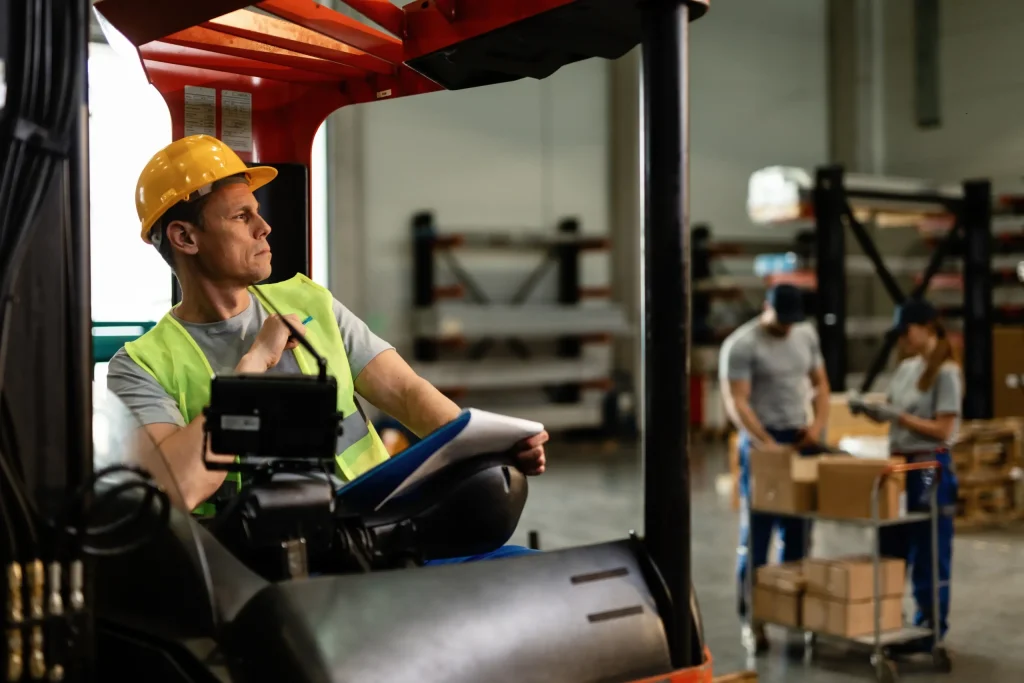
5. Walk the Entire Route the Forklift Will Travel
Don’t inspect only the starting point.
Follow the forklift’s complete route.
Imagine you’re unloading pallets from a delivery truck and moving them into storage.
The forklift may need to:
Enter a trailer.
Back onto a loading dock.
Turn.
Travel through a doorway.
Navigate around workers.
Enter an aisle.
Lift the pallet onto racking.
Every stage creates different space and operating considerations.
Walking the route beforehand can reveal problems you wouldn’t notice by looking only at the unloading area.
6. Outdoor Projects Need Different Planning
An outdoor forklift rental can be useful for construction, material yards, landscaping, infrastructure work, and other projects where loads need to be moved outside.
But outdoor conditions introduce variables that may not exist inside a warehouse.
Think about:
- Dirt
- Gravel
- Uneven ground
- Slopes
- Mud
- Drainage
- Weather
- Ground stability
A forklift designed primarily for smooth indoor flooring shouldn’t automatically be expected to handle rough outdoor conditions.
When arranging an outdoor forklift rental, describe the actual site instead of simply saying that the machine will be outside.
The more information available, the easier it is to identify equipment appropriate for the work.
7. Plan Loading Dock Operations Carefully
Loading docks can be busy environments.
Employees may be walking nearby.
Trucks arrive and depart.
Forklifts enter and exit trailers.
Materials are staged.
Space can become crowded quickly.
OSHA warns that loading docks create several forklift hazards, including falls from dock edges and slipping or skidding because of surface conditions. Its guidance recommends maintaining a safe distance from dock edges, watching for tail swing, and keeping working surfaces clear.
Don’t treat the dock as simply another warehouse aisle.
Plan how equipment and people will move through the area.
8. Check Trailers Before Driving Into Them
If your forklift will enter a truck trailer, additional preparation is important.
OSHA recommends checking whether the trailer floor can support the combined forklift and load and ensuring there is sufficient entry-door clearance for the equipment. It also identifies procedures for preventing trailer movement during loading and unloading.
These checks should happen before the forklift enters.
A schedule delay is inconvenient.
A trailer-floor failure or loading-dock accident can be far more serious.
9. Think About Pedestrian Traffic
Forklifts often share work areas with people on foot.
That requires planning.
Before the rental begins, identify where pedestrians normally travel and where forklift operations will take place.
Can routes be separated?
Are intersections clearly visible?
Are there blind corners?
Is material being staged in walkways?
OSHA identifies pedestrian safety as an important workplace consideration for powered industrial trucks and notes that workplace conditions influence forklift hazards.
A well-organized work area should account for both productivity and safety.
10. Match the Forklift to the Environment
Different jobs may call for different equipment.
A reach forklift rental may make sense for high warehouse storage.
An outdoor forklift rental may be more appropriate when work involves challenging exterior surfaces.
Another type of rental forklift may work well for general pallet movement, loading, or unloading.
Don’t begin with:
“Which forklift is cheapest?”
Begin with:
“Which forklift fits the work?”
Equipment that isn’t suited to the application may create delays that outweigh any initial savings.
To learn more about our approach to helping businesses and contractors find equipment suited to their projects, visit our About Us page and discover how Forklift Rental supports a range of material-handling needs.
11. Estimate How Long You’ll Actually Need the Forklift
Rental duration deserves planning too.
Ask yourself:
How much material needs to be moved?
How many deliveries are scheduled?
Will all materials arrive simultaneously?
Could the project extend?
Will the forklift be needed during multiple phases?
A rental period that’s too short can create unnecessary scheduling pressure.
One that’s much longer than needed may increase project costs.
Build your rental schedule around the actual work plan.
12. Coordinate Delivery With the Project Schedule
Your forklift doesn’t necessarily need to arrive at the same moment the first truckload of material does.
Give yourself enough time to receive the equipment and prepare for operations.
Before delivery, confirm:
- Site access
- Delivery location
- Gate dimensions
- Ground conditions
- Staging space
- On-site contact
- Work schedule
Equipment arriving before the work area is ready can create another logistical problem.
The goal is to have the forklift available when needed without making it an obstacle.
13. Avoid Last-Minute Equipment Changes
Last-minute changes can happen, but good planning reduces their likelihood.
Don’t discover on rental day that:
The load is heavier than expected.
The racking is taller than expected.
The doorway is smaller than expected.
The ground is rougher than expected.
The project lasts longer than expected.
Gathering accurate information early makes equipment selection more straightforward.
14. Make Sure Operators Are Properly Trained
Renting a forklift doesn’t automatically mean everyone on the job site can operate it.
OSHA requires employers to ensure powered industrial truck operators are competent to operate the equipment safely through the required training and evaluation.
This should be considered during project planning—not after the equipment arrives.
For detailed safety information, visit OSHA’s official Powered Industrial Trucks resource.
The resource provides information about forklift hazards, training, standards, loading and unloading, and workplace safety.
15. Don’t Exceed the Forklift’s Rated Capacity to Save Time
When schedules become tight, shortcuts become tempting.
Maybe there’s one unusually heavy pallet.
Maybe making two trips will take longer.
Maybe the operator thinks the forklift can “probably handle it.”
Don’t take that approach.
OSHA states that operators should not exceed the capacity shown on the forklift’s data plate and explains that oversized, off-center, or improperly positioned loads can reduce actual lifting capacity.
One extra trip is better than creating an unstable load.
16. Keep Loads Low While Traveling
Lift height is for placing and retrieving materials—not traveling around with the load unnecessarily elevated.
OSHA recommends keeping loads low while traveling and explains that raising the load shifts the center of gravity upward and forward, reducing stability.
Operators should follow appropriate procedures for the specific equipment, load, and work environment.
Safe operation needs to remain part of the project schedule even when crews are working against a deadline.
17. Have a Plan for Changing Site Conditions
A job site isn’t always static.
Construction projects evolve.
Materials accumulate.
Weather changes outdoor surfaces.
Delivery vehicles arrive.
Pedestrian routes shift.
Warehouse inventory changes.
The conditions present on day one may not be identical on day ten.
Continue evaluating the work environment throughout the rental period.
If conditions change substantially, determine whether the original equipment and operating plan remain appropriate.
18. Consider Rental Equipment for Temporary Demand
A business doesn’t necessarily need to purchase another forklift because workload temporarily increases.
A rental forklift can provide additional capacity for situations such as:
- Seasonal inventory
- Warehouse reorganizations
- Large deliveries
- Construction projects
- Facility expansions
- Equipment downtime
- Temporary contracts
- Short-term production increases
Rental equipment can help businesses respond to changing workloads without immediately committing to permanent equipment ownership.
19. Give the Rental Provider Complete Information
When requesting equipment, be specific.
Instead of:
“I need a forklift next week.”
Provide information such as:
“We need to move 3,500-pound palletized materials from delivery trailers across an outdoor gravel area and place them approximately 12 feet high.”
That description is much more useful.
Include:
- Maximum load weight
- Load dimensions
- Lift height
- Terrain
- Indoor/outdoor use
- Aisle width
- Clearance
- Rental period
- Project location
If you’re coordinating equipment for projects across multiple markets, visit our Service Areas page to explore where Forklift Rental helps contractors, warehouses, businesses, and industrial operations access the equipment they need.
Better Planning Keeps Material Moving
Forklift downtime doesn’t always happen because equipment breaks.
Sometimes it happens because the wrong equipment was selected from the beginning.
The forklift can’t lift high enough.
It doesn’t fit through the doorway.
It isn’t appropriate for the terrain.
The load exceeds its capacity.
The delivery wasn’t coordinated.
Those problems are often preventable.
Before reserving equipment, understand exactly what needs to be lifted, where it needs to go, and what conditions the forklift will encounter along the way.
Keep Your Project Moving With the Right Forklift Rental
Whether you need an outdoor forklift rental for a demanding job site, a reach forklift rental for warehouse operations, or another rental forklift for temporary material-handling needs, planning ahead can help you choose equipment that fits the project from the beginning.
Forklift Rental helps contractors, warehouses, industrial facilities, and businesses find equipment based on their specific material-handling requirements. By considering capacity, lift height, workspace, operating conditions, rental duration, and delivery needs before the project begins, you can spend less time solving equipment problems and more time getting the work completed.
Contact Forklift Rental today to discuss your project, check forklift availability, request a quote, and arrange the right rental equipment to keep your materials—and your project—moving.